skip to main |
skip to sidebar
for orchestra “Wherever you turn, there is the Face of God.”
-Qur’an Surah Baqara 2:1115
The Dervish are members Sufi Muslim mendicant ascetics known for their poetry. Unlike the Mullahs, they have taken vows of poverty. The “whirling Dervishes” dance comes from the Mevlevi Order in Turkey who traces its origin to the poet Rumi. The dance slowly accelerates over minutes or hours to an ecstatic spiritual climax. The sect is still active in Turkey, and is led by Rumi’s 20th great-grandson.
This Dervish does not attempt to imitate traditional Mevlevi music (which typically includes a male choir). Instead, I have borrowed freely from Middle Eastern music, Romani music, Bollywood, and contemporary classical techniques. The main reference to the Dervish is in tempo. The work very slowly accelerates through the first half before collapsing into a “perpetual” accelerando in which the tempo constantly accelerates even while the overall feeling of motion remains strangely constant. The work ends with a dramatic rit. all the way down to quarter=0.
visit
www.mooneast.com
for orchestra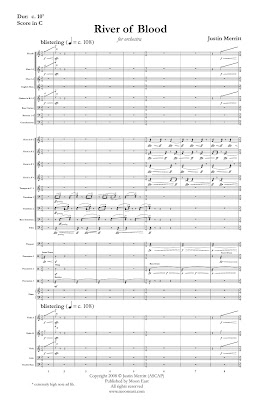 River of Blood is based on a 1980 massacre of Salvadoran peasants at the Rio Sumpul by right-wing military forces armed and trained by the United States. Six hundred civilians were killed in the attack. Women were tortured to death, and babies were cut apart with machetes.
River of Blood is not a tone poem mimicking the actions of the day but is rather a collage of images and emotions from that tragic time. Images include violence but also the incredible bravery of Salvadoran journalists who tried to tell their country and their world what was happening, human rights campaigners risking their lives in the face of terror, and the faces of the fishermen who found the bodies of 5 children caught in their fishing traps downstream from the massacre. The work ends with a prayer of mourning and a plea for forgiveness for our involvement.
I first became aware of the massacre while composing a choral work, Hay Días, a setting of a poem by Salvadoran journalist Jaime Suárez Quemain who was murdered by the same junta a few months later. The poem ends:
It is then, sir,
when the enemies of roofless children
walk silently
shadowed by the moonlight
and rap on the doors of angels
and take them away, bound,
to dig a grave
where flowers will grow.
(translated C. Alegría & D. Flakoll)
visit
www.mooneast.com
for orchestra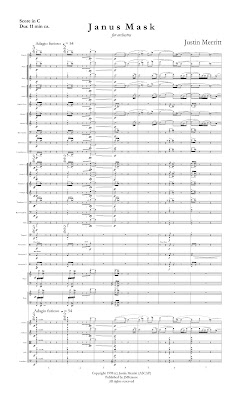 Janus, the Roman god of gates and doorways, is portrayed in masks as having 2 faces, each pointing in the opposite direction. Liars and traitors are sometimes described as being Janus-faced because one is never sure which is the true face. Like the mask, this work is divided into two opposing sections. The first half of the work is an aggressive Allegro in which a series of increasingly powerful climaxes which finally explode and extinguish themselves in a furious culmination. The second half of the work, marked Lento desolato, is an incredibly slow and tortured progression. The work ends with a huge build toward a somewhat triumphant note, indicating a new beginning beyond the next gate.
In 2001, Justin Merritt, became the youngest-ever winner of the prestigious ASCAP Foundation/Rudolph Nissim award for Janus Mask.
visit
www.mooneast.com
for string orchestra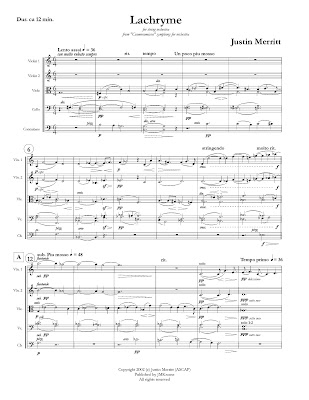
Lachryme is the 5th movement to a very large, as yet unfinished, symphony – Cosmonomicon. The symphony begins with the beginning of the universe, appropriately entitled Con fuoco (with fire). Unlike the glassily frozen beginning to the world depicted in Mahler’s first symphony or the majestic stability of the opening of Strauss’ Also sprach Zarathustra, Con fuco shows a world born of intense energy and chaos. This ball of heat cools in the second movement, Celestial mechanics, into a slowly rotating portrayal of the cosmos. Canti vivae moves closer to home, and in a simple but lively texture, it depicts the evolution of life on earth. Darkness creeps into the picture in Scherzo macabre (danse humana). The history of humankind through war & discord is recorded with dark humor.
Lachryme literally means tears, and this work was originally subtitled “weep for our souls.” This is the most personal of the five movements, and it reflects on how such a beautiful and awe-inspiring world can contain such misery and desolation. The final bars, however, point toward a different resolution.
The symphony ends with Adoramos, which expresses a final acceptance of our infinitesimally small place in the cosmos, and reflects how the fantastic size and sweep of the universe overwhelms our personal desires and pain. That a true internalization incredible smallness in the face of empty space, gives us a better understanding of God.
The movement that you will hear tonight, Lachyme, is deceptively lyrical and direct. It pushes the string orchestra to function as both an orchestra and as a very large chamber group. It is at times divided into as many as 16 parts and uses 10 different soloists. Its lyrical flexibility is, perhaps ironically, created by using precise and complex combinations of rhythm. At many points in the work parts of the ensemble are dividing the beat into 3 parts, while the remainder divide the beat into 4 parts. In addition, these divisions are further subdivided. However, rather than sounding merely chaotic, the result is an achingly intense stretching of the beat. I find these rhythms such as 4:3 that exist on the boundary between order and chaos to be both fantastically interesting and musically rich.
The harmony of this work is constructed using a new harmonic framework I’ve developed that utilizes harmonic circles other than the circle of 5ths to generate modes and harmonies. These circles are beautifully symmetrical, but yield rich and fascinating new harmonic motions.
visit
www.mooneast.com
for orchestra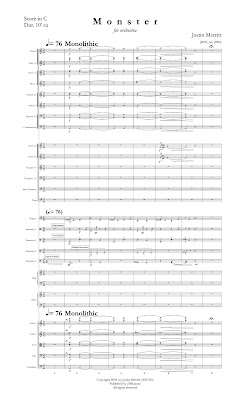
Monster opens with a huge, slow-motion chorale accompanied by an intense percussion polyrhythm. The power of the opening is disrupted by a series of rough, highly rhythmic grooves. Rhythmic fragments flash back and forth from within the texture. This texture gives way to a persistent, comic ostinato in the bassoons. The piece erupts into an intense single-voice tutti toccata based on the bassoon ostinato. The sound of this toccata is based on organ registration, with shifting timbres and ever-present organum. The effect is like an enormous organ pulling out stops until it explodes into a muscular percussion break. While drums dominate, the tutti orchestral ensemble is also used as an additional percussion instrument. The break gives way to bursts of pp woodwind flurries. These flurries evolve into tutti scurries throughout the range of the entire orchestra. This builds to a giant restatement of the opening chorale with an intense percussion groove. This in turn culminates in a giant fff tutti trill.
The trill evaporates into the misty second section of the work. A high harmonics ostinato in the violins accompanies soulful melodies in the low strings. Woodwind fluttertongues and an arpeggiated flurry briefly disturb the placid texture. To this sound is added percussion metals all arco (with bows). This sound field, consisting of overlapping strings playing harmonics arpeggios, gives a glistening, sparkling sheen. The monster slowly recedes into blissful nothing.
visit
www.mooneast.com


